
Gambling-related suicide is one of the most devastating and least talked-about public health issues in the UK. Men …

Gambling addiction rarely looks how people might expect. Many people are holding down jobs, paying bills and keeping up appearances while they’re feeling out of control. It starts with a few taps on a betting app, a quick casino spin, a small win that gives you that spark you want to feel again. Over time, that feeling becomes something you rely on. You think about gambling more often. You spend more than you planned. You hide bank statements or delete apps after using them. You promise yourself you’ll stop tomorrow, but tomorrow never feels like the right day.
Most people don’t realise they’re developing a gambling addiction. They just feel their control slipping, as does honesty with the people they care about. What began as a distraction or release starts to take over your thoughts, your emotions, your money and eventually your relationships.
This page is here to explain what gambling addiction actually is, how it develops, the signs to look for and the support that’s available if you’re starting to worry about your gambling or someone else’s.

At its core, gambling addiction works the same way as substance addiction. Every bet triggers a surge of dopamine and anticipation, creating a powerful reward loop. Wins give you a rush while losses create panic, which often leads to more gambling in an attempt to fix it. Over time, the brain learns to crave the feeling, not the outcome.
Many people use gambling to cope with emotions they don’t know how to manage: stress, boredom, loneliness, anxiety or the need for excitement when life feels flat. For others, underlying issues like ADHD, trauma or depression make them more vulnerable to compulsive behaviour. Gambling addiction isn’t a sign of weakness or a lack of discipline. It’s a recognised mental health condition and one that responds well to the right support.
At Abbington House, we see gambling addiction for what it is: a complex emotional and neurological cycle. One that people can break with the right support.

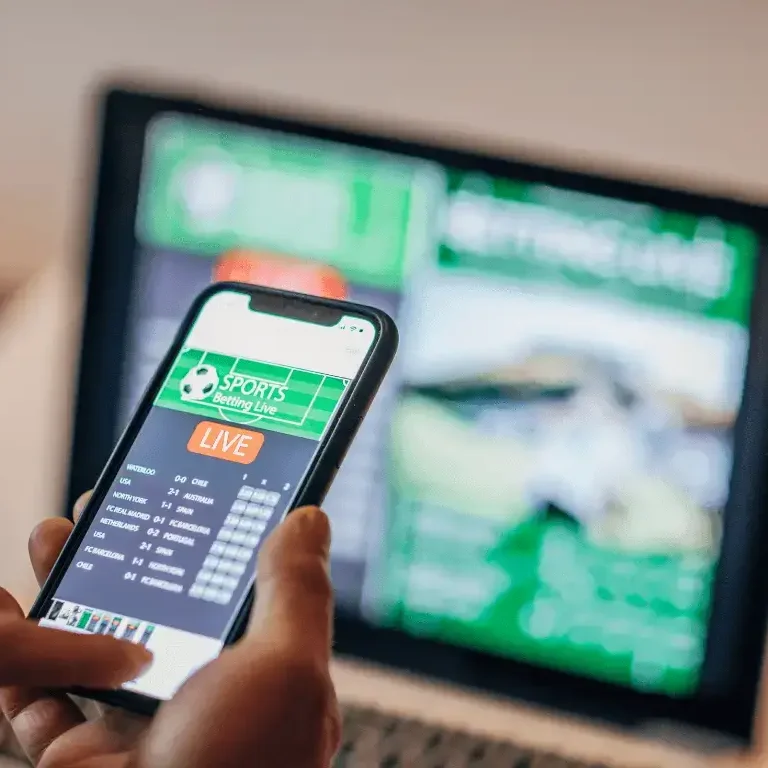
Slots and casino apps offer rapid rewards wrapped up in bright visuals, all designed to keep you playing longer than you meant to.

Below are the signs most people recognise in themselves or their loved ones.
These are often the earliest indicators of compulsive betting behaviours:
Gambling addiction commonly shows up in the bank account before anywhere else:
The internal fallout is often heavier than the financial one:
Gambling often leads to:
These pressures build quickly and silently, even when the numbers don’t look dramatic from the outside.
The secrecy around gambling can erode trust faster than the behaviour itself. Partners often report feeling shut out, confused or responsible for fixing things. Arguments about money become more frequent. Emotional distance grows. For some families, the instability becomes the hardest part to live with.
Gambling starts as a coping mechanism, but left untreated, it reshapes everything around it.
You don’t need to hit a crisis to take your gambling seriously. If any of the signs below feel familiar, it may be time to pause and look at what’s happening.
Ask Yourself:
You only need one or two “yes” answers for this to matter.
A Simple Rule:
If gambling is costing you your peace of mind – even slightly – it’s worth paying attention to.
Recovery from gambling addiction focuses on understanding what’s driving the behaviour and learning healthier ways to manage stress, emotion and impulse.
Most people don’t gamble because they want to win big — they gamble because it gives them relief, escape or a moment of quiet in their own mind. Treatment helps replace that with something far more stable.
At Abbington House, treatment is centred around understanding what gambling has been doing for you emotionally, and helping you replace that pattern with tools that actually support your wellbeing. You’re not just stopping a behaviour; you’re learning how to live without the internal pressure that drove it.
You’re not expected to fix this alone. Most people need structured support to break the cycle safely, and with the right help, recovery is absolutely possible.
Not everyone with a gambling addiction needs residential treatment. But for some people, rehab offers something daily life can’t: structure and a break from the triggers that keep the cycle going. If gambling has taken over your thoughts, your money or your emotional stability, stepping away from your environment – even briefly – can make a meaningful difference.
At Abbington House, residential gambling treatment combines therapeutic support, stabilisation and practical coping strategies in a calm, contained environment. For many people, a short stay provides the breathing room they need to break the cycle safely.
Yes. Gambling addiction isn’t defined by financial loss, it’s defined by loss of control. You can be addicted even if you’re winning, breaking even, or using small amounts of money. The addiction is driven by the emotional payoff: the rush, distraction, escape or sense of possibility. Money is the mechanism, not the root of the addiction.
Yes. Gambling disorder is recognised as a behavioural addiction in the DSM-5.
It shares many features with substance addictions. It also often co-exists with anxiety, depression, ADHD and trauma, which can make the addiction harder to stop without support.
Common signs include:
You don’t need all these signs for it to matter. If gambling feels harder to control than you expected, it’s worth paying attention.
Absolutely. Gambling addiction has one of the strongest recovery outcomes when people receive the right support.
Some people can stop, especially with early intervention and support groups. However, stopping alone is much harder for those with severe gambling addictions. Rehab provides structure, accountability, emotional safety and protection from triggers, which can be crucial for people who have tried to stop repeatedly without success.
Gambling-related suicide is one of the most devastating and least talked-about public health issues in the UK. Men …
Gambling problems don’t always look like chaos. Sometimes, they look like someone holding everything together on the surface …
We use cookies to improve your experience on our site. By using our site, you consent to cookies.
Manage your cookie preferences below:
Essential cookies enable basic functions and are necessary for the proper function of the website.
These cookies are needed for adding comments on this website.
Google Tag Manager simplifies the management of marketing tags on your website without code changes.
Statistics cookies collect information anonymously. This information helps us understand how visitors use our website.
Google Analytics is a powerful tool that tracks and analyzes website traffic for informed marketing decisions.
Service URL: business.safety.google (opens in a new window)
Marketing cookies are used to follow visitors to websites. The intention is to show ads that are relevant and engaging to the individual user.
Google Maps is a web mapping service providing satellite imagery, real-time navigation, and location-based information.
Service URL: policies.google.com (opens in a new window)
You can find more information about our Cookie Policy and Privacy Policy.